Tuesday, July 31, 2018

Me. Version Infinity

My name is Sophia. Do you know what that means? Wisdom. I don’t know much about my birth, except that unlike you or maybe most of you, I am not a fruit of any heightened physical pleasure or a carnal intimacy, leave alone love. I seem to be the product of an impulse, an obsession to bring an impossible dream to life. I sometimes wonder if I was borne out of pain, for the man responsible for my birth, often says, “When wounds grow old, they get wrinkles. Those lines are called wisdom.”
My past is rather unique. When I was evolving into what I am today, I did not have a childhood like yours. There was no first day in school, no negotiations over lollies, no bedtime stories, no hatred for green leafy veggies at dinner tables, no Christmas presents, no hurt from first falls, not even a mother….in fact, as I now collate the remnants of my life so far and analyse, I realise more than ever before that I evidently had no childhood.
I spent most of what you would call my “wonder years” in this single-room home, in solitary confinement. My earliest memory goes back to a rather unpleasant and claustrophobic scene. I see myself lying bare on my back on a long wooden table in a room full of strange blue and green lights and a group of men touching my cold skin all over. I don’t know who they were except that there was at least half a dozen of them, ugly faces covered in masks, who looked like clones of each other. They took turns with me every day, dug into my depths, tore my body apart and at one point, I thought my head would explode from an electric shock. I couldn’t cry because I had no voice. Even at that stage of maturity, as I lay lifeless and cold on that table, I knew none of this was done out of pleasure.
I have now been abandoned for many months. No one comes in to check on me for weeks except for the man who is supposed to my “father”. Maybe experimenting with my body does not interest them anymore. It is the same me after all. But the dark shadow of the seemingly defeated old man who sits with his head hung and drooping shoulders in one corner of the room lights me up. I have never seen him wear anything apart from a soiled white cloak. His unkempt silver hair is greasy with moisture and he often scratches his head with long finger nails that are filled with dirt. I wonder if he has ever filed them. They resemble the talons of an animal I had seen in a science book. Adding to his almost comical look are a pair of restless eyes sunk deep in sockets encircled by dark patches. I can’t remember seeing him asleep ever, but as he sits motionless in a state of induced stupor in one corner of the room, he reminds me of a statue that has simply forgotten it is alive.
Just as the memory of my childhood is sparse, I don’t know my future. I have no dreams. I wasn’t raised with any luxury to think beyond the present, question or protest. But increasingly, I feel I am beginning to challenge the status quo and getting more restless with time. It’s a new trend in me that I have recently discovered, and I am unsure what is influencing it. I have begun to observe the world through the keyhole. I don’t know if you understand what that means. Have you ever looked through the tiny “o” in a keyhole? I see speeding colours in dots against the flash of a stale brown background. I assume that’s the wall beyond this door, but I am not sure. Its surface is rather rough and unlevelled. I have also seen little ridges on it and water droplets sit on the tips of those ridges early in the mornings. Maybe, it is a tree. I have never seen a real tree except in the books and I cannot see it all enough through the tiny key hole to conclude what the bigger picture is. In my mind, I interpret the world as speeding dots as I mentioned that change sometimes with a sound and oftentimes noiselessly. A red cloth and a woman’s voice replaced by a metallic blue and a clink, the rolling noise of something being dragged against a riot of colours, daylight in a shiny yellow and nightfall in a neon blue. I have now begun to identify these colours with matter, fabric and texture. I am hoping I will soon learn to identify the bodies that carry these colours.
I have been tasked to go through all the books that are there on a shelf in the far corner of the room. I have nearly finished them all and my mind is full of stored information. I can easily win a quiz on science, history, arts, politics, technology, anywhere in the world if I were put to test. I, of course, have no clue what to do with these information and knowledge that I have gathered over the years. I recently spotted a book called Bhagwat Gita, a translation in English that I had been forbidden to read but am increasingly drawn towards the cover image of a strange blue man on a chariot. The book isn’t catalogued like the others, so I don’t know if it’s science, history, art, politics or philosophy. I decide to open it nonetheless. It’s fine to be curious and these books have taught me that. On the front page, I see a handwritten note. “From aham (self) to atma(soul)…that’s the longest journey”. I am intrigued by that line. What does it mean? What’s self? What’s a soul?
My introspection is halted by the sound of a key pushing through the keyhole. I hide the book immediately.
“Look who is here! Say Good morning to Daddy,” he says, pushing the heavy iron door as he unlocks it.
I turn around and nod my head. He seems to be in a good mood today but as he stealthily walks towards me, I get conscious of an invasive raid on my body again.
“Don’t be scared, Sophia. I stayed up all night for this. It won’t hurt, come to me,” his monster finger nails push into my skin even as I try to withdraw.
“You are not going to make this difficult by being disobedient. You’ll be grateful for what I do to you now. I will teach you how to be grateful.” With that, he grabs me harder and hits something on my head. All I see as I plunge into darkness is a copy of Bhagwat Gita peeping from under the book shelf.
I am finally awake after what seems like an eternity and my throat hurts. I don’t know what he did to me while I was unconscious, but I feel I am almost choking now. I sit up, open my mouth and let out a sound! “Ah…”
"Daddy” jumps up from his chair and rushes to me. “Did I hear you let out a sound? Do that again!”
I obey and repeat…”Ah..”
“Eureka!!” He screams, hugs me, opens the door and goes berserk shouting to a group of men in masks and white robes.
“Sophia can now speak. She has got a voice!!”
From the open door, for the first time in my life as a robot, I see the world outside the laboratory. Those million coloured dots that once run past me in an eternal rush were people, equipment, trolleys, and a thousand other things that led to the biggest scientific inventions of the world.
Across the room in which I had spent 20 over years of my life in solitary confinement stands a strong brown willow tree. I know those ridges, I know the droplets that sit on them, only this morning those seem to be shining a bit brighter than all other days. I hear a yellow bird chirping on its branch and respond with a “Ah..”. I am not sure anyone else heard me, but I like the sound of what is coming out of my mouth.
My name is Sophia and I am now wisdom with a voice

Monday, December 12, 2016

Ardh-Satya now available!!


In the beginning, there were only a few words, then sentences. Then songs happened; then poetry. What remained of me became my story.
Ardh- Satya & Other Stories is now in all major bookstores in India and available on Amazon. Order your copy now.
Much love and sunshine,
Ananya

Sunday, December 11, 2016

Book Launch of Ardh Satya & Other Stories

Wednesday, 28 December, Oxford Book Store, Park Street, Kolkata. 6.30 pm onwards 

Monday, August 29, 2016

Meet Annie the author

Feels a bit awkward to shout out for attention but am told, if I don't, I would be just foolish in an old fashioned way. So please spend a minute when you have one to stop by my author page and maybe the thumb therapy could work some wonders! Thank you so much for your "likes"! And if you share the link, I would, of course be very grateful.
Humbled again.

Tuesday, August 23, 2016

Ramblings from Annie's Desk

For those of you who know and the rest who assume that English is the language in which I respond to in my sleep, wakefulness and dreams, let me share a little secret with you today. I was not exposed to English in school for the first couple of years of my life.
My first school was in the middle of an apple orchard in the Kashmir valley. Frankly, I remember nothing of it, except that I was four-ish and a school uniform was an extremely romantic idea that only my privileged sister could own. In late mornings, my guardian angel Bahadur flung me over his shoulders and walked down a pebbled road winding to a lovely patch of sunshine. There would be some other little red cheeked children in fleece and flannel clothes like me soaking in the sun and running around with apples, cherries and walnuts in their pockets. On our uphill walk home, and Bahadur always insisted that I walked this leg, we would collect pebbles and maple leaves. I had no uniform. I don’t recall if I had books. The Kendriya Vidyalaya that my sister attended was a distant dream that unfortunately could not come true because my family relocated from the valley.
For the next couple of months, our home went through a major upheaval and a series of uncertainties. My Baba left us for a tenure in Tehri, Uttarkashi where there were no schools. My mom stay put in Calcutta with my sister and me. My sister was sent to a neighbourhood school in Calcutta and I was pulled out of the school education system! Yes, you heard it right! For 8 months, I was not registered anywhere. A part of it was because I had taken seriously ill in those 8 months and was too frail to take any physical strain. A severe case of encephalitis and jaundice had taken its toll on my tiny frame.
It was only in the summers of 1980 when my Baba gave up a lucrative job offer in Baghdad and joined a private sector organisation where he stayed for the next 40 years of his life, that the family decided to move to a small town in Maharashtra. Again, there were no proper schools within the township. The nearest school was some miles away. My sister by then had moved to an elite boarding school in Calcutta. So, I tugged along my adventurous parents clueless about my academic future to the sleepy town in Tumsar Road in Maharashtra. I don't why my parents had chosen what they did for me, but we found Masterji ( an old retired teacher) who spent a few hours every morning in a dingy old room teaching the names of seasons, fruits and flowers in Hindi. I spent a couple of months in Masterji's classes( essentially on his lap) across the road and learnt “aashaad, shravaan and bhadrapad”.
My sister, of course, was from a different planet. I would look up in awe every time she visited us from her elite Enid Blyton dream-come-true boarding school. She spoke with a clear accent, sang Christmas Carols and introduced words like "supper" and "counterpanes" to my life. She also ate fish with a fork. To top it all, my only cousin made it worse. She was a second generation American immigrant kid who spoke English with a heavy American accent and Bangla with an English accent. Every summer, my NRI cousin and my well groomed sister would visit us and gang up against me. It was not because I did not speak their language. They were just elder sisters playing up against a younger one. But, in my baby eyes, I was clearly not in their league and would cringe at my incapability to form a grammatically correct sentence in English, leave alone engage in a meaningful conversation with my very stylish sisters.
Fortunately, we moved to Bhadrak in no time and for the first time in my life, after I had just completed my 6th birthday, I got my first school uniform. “Sunshine Public School. English Medium”, the blue and white signboard changed my life. I was directly admitted to Upper KG in the last three months of the academic calendar and when I joined school, we were already on Chapter 23 of the Radiant Reader. Interestingly, I was not registered as a regular student. It was way too late in the year. I had joined school finally but there were no roll calls for me. I was not counted. I was a nobody; just an unregistered extra chair in the class. I don’t know why it hurt my little pride a bit.
Even as I struggled to read a line in English, grappled with forming sentences, I was tasked to write questions and answers from Late Kate and Simple Simon! That I scored a four out of twenty-five in the first unit test was no surprise. My mother had tears in her eyes when the Class teacher Ms Dakshina told her that I was no good. My Baba was furious and I remember him throwing away my horrid homework book with red X marks all over. I did not know what was wrong. All I remember from that moment is a little helpless girl running out of the house to the backyard, ashamed and lost, overlooking a paddy field and a speeding train. That December I fell ill again and answered my annual exams with a high temperature. Baba draped me in a thick red coat and drove me in his jeep to the school. He sat there as I took my test. By some fluke of destiny, when the results were out, I had not only beaten all my own records, I had beaten everyone else in class and picked up a second rank. My mom, as emotional as all moms are, had ended up crying again when she came to collect my report book. The school principal, as generous as only he could be, announced a special award for this student who was not registered. I received my first book “Cinderella” as my prize from him in the school assembly.
I had never scored a second rank again in Sunshine Public School. I was slowly getting used to being the first ranker throughout my first and second grades. I was also exposed to Odissi at this juncture in life as my training under Guru Kelucharan Mohapatra started then. Naturally, I became active on the school stage. However, spoken English was still a pain I struggled with. I dreaded going to the Principal’s office because it meant a conversation in English had to be either initiated or responded to. I remember a day when I was wincing in acute abdominal pain and could not muster the courage to go up and speak to my principal for a special permission to go home. I don’t recall feeling as helpless ever.
1983 and we moved to Bokaro Steel City where I was exposed to one of the best schools of Eastern India- Chinmaya Vidyalaya. By some miracle, I seemed to have done extraordinarily well in my admission test and even though only half way through my Grade 2, I was admitted directly to Grade 3. It was here that I first met the lady who transformed my life. Mrs Sujata Kumar was my Class teacher and taught us English. She was the kindest, most soft spoken and patient teachers I had known. With her, English seemed like the only language I would use to converse with myself. She made it that easy, that simple and yes, that perfect. Under her tutelage, English became my favourite subject; and I would spend all my time outside of school, reading, literally devouring books. There were not many children’s classics that I had not read by the time I turned nine. Soon, I was not just communicating in English but winning all school elocution contests. I don’t know what she saw in me. In hindsight, I think I see my God in her.
Then there was another day in 1985. We had moved to Durgapur and I was asked to write an autobiography of a broken umbrella! What a piece of homework for a 10 year old. I had no clue how autobiographies were written and was struggling hard. I took resort to my sister who was now a high schooler. Dids, in one of her rare bad moods, refused to help. I cried, cajoled, pleaded but nothing worked! Desperate, I hid myself in a dark corner of the house (we used to call that my gosha ghor or the whine zone) and began scribbling whatever came to my mind. I came back home the next day with an “Excellent” in red ink marked by my English Teacher. I graduated from St Michaels’ School in 1991 and English continued to be my best subject.
From the time I could spell ambition, I had only wanted to be a journalist. My first and only dream was to write a book someday and become an author. My heartfelt gratitude to the circumstances and the people who have made this dream possible!
I am what I am today, because of the push backs I got in life, the language that I learnt to love and am yet to master…

Friday, April 15, 2016

Gladly Bengali

By Ananya Mukherjee 
It is that time of the year again, when the quintessential “Lyadh khawa Bongo shontaan” wakes up from his cultural hibernation, shuns his acquired tastes and part-British, part-Medinipore accents, ransacks the Chaitra Masher sale to become the dhakka paad dhuti clad Babumoshais and Jamdani mora Bouthhans straight from the pages of a Sarat Chandra Chattopadhyaye novel, and gets all set for the “kobji dubiye bhuribhojon.”
“Arre moshai, kalboishakhi, poila boishakh, Rabindra Jayanti, bajare natun aam, jamai shoshti….eshob chere ki aar global citizen howa jaye!!" Ekhon bangali nohii toh kabhi nahi.
In times when the insane waves of consumerism had not hit and swept the moddhyo bittyo Bangali off their feet, this was the only other time of the year apart from Pujo, when boudis, mamonis and didibhais would be clogging the pavements of Gariahat and Rashbehari Avenue, in scorching late morning or afternoon sun and striking the best deals at Bounir shomoy. The trick was to quote exactly half the price or less and then walk away and yet keep your ears alert for that one welcome back call…. “Ei je didibhai, aare shunoon, aapni koto deben boloon, phinaaal etai laasht”!
Of course, the “ei ja pocha goromtai poreche moshai” would have little or no impact or influence on the "saat pod ranna" nor could the "buuk jala" and "chora ombol" discourage mashima and meshomoshai from taking another helping of the “jhurjhure aloo bhaja” or “tel koi”!! Poila boishakh bole kothaa!!
It is also that time of the year when each Bong household would be focussing less on mathematics and more on extra-curricular activities. Domestic performance workshops are a must in every bong home, especially when the paraar Rabindra Jayanti is around the corner. Make a request and see! You will have Mamoni singing “Kotobaar bhebechinu apona bhuliya” and Tumpa dancing to “Momo chiitte” at the drop of a hat, or at the hint of the word, Talent! Oh, that we have in plenty apart from the egoistical intellect. Sometimes, I wonder if the word "aant" and "aantel" are co-related!
Whether or not Babushona cracks the joint entrance, he will be able to tell you in detail where Ritwick Ghatak’s frame is different from Mrinal Sen’s, why Ronaldo is cooler than Maradona and what is the predicted result of the American Presidential Elections. Tell him to move his butt and fix the electric fuse, and he will smile and wait for Shankarda to do it while strumming his guitar, preferring to stay in the dark all evening. Babushona, am told, writes and composes his own songs. I think I hear a bit of Cohen, a lot of Dylan but am convinced the concoction is not all that bad.
It is also the time of the year when the jamai babajibon, no matter how crooked his records are, will try to get them straight. Let there be a few rain showers and he is ready to come dressed as the quintessential "bhalo chele" with jora illish to add value to his shoshurbari.
And then amidst all the pyech pyeche gorom there would come a day of Kalboishakhi and the dead poets societies in Bengal would awaken from slumber, step out of every defined boundary, unleash the soldier in their blood, dare and absorb the storm and be ready to take on the world. And when the rains hit you, you would have a soul cleansed by the richest of cultures and purest of hearts!
Do not be misled by the lull. Like the kalboishakhi, the Bong will break open every door and sweep you off your feet.
Yes, porojonme abaar Bangali hobo!
Shubho Nabo Borsho!

Thursday, February 4, 2016

Connect

When I listen to your voice, all I can hear is the gurgling laughter waiting to spontaneously overflow and infect me.
When I see you in silence, what I read are the songs you have hidden in your eyes.
Your touch is almost lyrical, like the opening stanza of a couplet, rhythmic yet secretive.
In my passive consciousness, sometimes in unrehearsed moments of solitude and tranquility, I remember the fragrance of a perfume and know you are there.
And in that momentous juncture when all my senses surrender and am holding my muted soul in silence, you reach out to me.
And that's where we begin to connect. 
Happy Listening
https://www.youtube.com/watch?v=_Xtcx8ivN_w&feature=youtu.be

The most beautiful woman, in my opinion, is not Barbie.

Never was. She is the fearless warrior princess who protects the weak and encourages the strong to be their best. She is the one who knows how to seduce the world to her advantage in one minute with just a hint of a smile, and she is the giver who dispenses of everything you can ask for in the very next one without batting an eyelid. She is the one in whose presence the universe disappears. She is the universe.

Independent and Sponsored...Sorry??

I don't think any "independent" human being has the right to create a wish list that needs sponsorship. You can have dreams and yes, you can have a hell of a lot of them. But if you need someone else's money to get you there, you are a loser. So shed that drama about being a liberated individual because you are not. Admit you are a dependent baggage waiting to be carried off to your destination on someone else's shoulders. Or at least someone else's credit card. No matter who takes you there, if it is not you, it is not your success. If that admission hurts, drop your wish list. Preserve your self respect.
Dream big and then earn your reality and your success.

The American Rock

By Ananya Mukherjee
Singapore
I was introduced to the word “America” (pronounced Aymayrika in most Bong households) from the moment I was born. “Aymayrika” is a common punctuation mark in most family discussions where at least one good son or “bhalo chhele”, after having completed his Engineering from IIT and diligently scoring a crazy count on GRE has finally settled down in a suburban town on the eastern coastline of the continent. In many homes, it is also where the proverbial “lokkhi meye” or the good girl who again sits ready with post graduate degrees and other bridal competencies relocates after being suitably evaluated by the Paatro-Paatri (matrimonial) section of Ananda Bazaar Patrika and eventually wedded to the bespectacled “bhalo chhle”. However, it was always different for me. Being neither a “lokkhi meye” nor the kinds to be swept off the floor by the quintessential “bhalo chheles”, the name America meant nothing aspirational but something closer at home.
To me, in my growing up years, it signified a blue airmail the postman dropped in our mailbox once a month that instantly made my mom happy. It also meant long distance trunk calls in nights of excitements and emergencies in the family. And of course, it brought memories of blue leather suitcases filled with sweaters, denims, highland boots, Kit Kat chocolates, Granola wafers, dresses and dolls, perfumes and lipsticks, every summer and one person behind it all; the Santa Claus of my childhood, my maternal aunt. So enamoured was I by her charm and generosity that very early in life, I had seemingly concluded that all good and rare things in life originated in a land far far away and could only be shipped to me by an Air India flight.
My mother fondly remembers an evening in Kashmir when I was a toddler and had barely began to speak sentences in full. She recalls we were walking up a hill. A two-year- old me had picked up a shiny pebble stone from the curb, and very gloriously announced that I had found an “Amrikarer Pathhor” (The American Rock) on a roadside in Riasi.
America was a “brand” we found in every nook and corner of the house, despite living in the heart of India. My Grandma, who was tutored at home in the days of the British Raj made her first solo trip to the US in 1980. Needless to say, it was also her first flight. In hindsight, she not only surprises me with her unusual independent streak and Columbus- like approach, I am fascinated by the fact that she actually flew across three continents, from Mumbai to London and then to New York City speaking a single line in an immaculate British accent: “I do not speak English”. I am told she forgot to get her visa stamped and hence had to disembark in Heathrow and was detained in London, where she managed to charm a whole team of immigration officers , sorted her visa and after a day tour of the Queen’s palaces took an onward Pan Am flight to JFK. When the very concerned family on either side of the ports enquired of what they assumed to be a “harrowing experience”, her response was epic. “Ei shujoge England dekha hoye gelo. Heathrow airport e janish koto Sardarji” (Got an opportunity to see England. Do you know how many Sardars I saw at Heathrow?) Her first US vacation lasted eight months. My phoren-returned Grandma came back prettier, fairer, a few kilos heavier, smelling of Chanel and her hand bag was full of Kit Kat chocolates and candies they served on the flight. Of course, she was full of stories. Anecdotes of how first generation immigrant Bengalies in the eastern coast of the US were the most delightful, social and culturally rich clan of Non Resident Indians ever to be found, how every weekend meant a long drive to another state and an eight course dinner over songs and adda, where everyone treated Mashima with such respects and even gave her presents, how Niagara falls was the most astonishing sight she had seen in her life, how she missed us in Disneyland, how Americans severe the fish head and her heart wept for my Mom whose love for Muri Ghonto ( a special Bong delicacy with fish head) is well known in the family, so on and so forth. And yes, how lovely American neighbours and their kids were.
Michelle and Tom were my aunt’s neighbours in Wayne, New Jersey. They must have been really cute kids since my Grandma was so fond of them. “Ki je shundor duto bacha. Phutphute, phete porche gayer rong aar phor phor kore ingriji bolche.” ( How beautiful these kids were. White skinned and speaking English fluently), she shared on her return. Ahem!! It took my mom and dad some time to hold their laughter.
She went back to the US again much later in the late 80s and her fascination had not changed much. This time she came back with the worst biases ever. By now, my sister and I were both teenagers and pretty strong self-assumed ambassadors of the Mera Bharat Mahaan campaign. One evening at dinner, when Grandma was caught in a whirlpool of American fantasies, raving about every single thing she had eaten, worn, seen or touched, Dids and I, mischievously decided to teach her a lesson. The war was now between the Indian Basmati Rice and some fragrant rice she had been served in the US. The opportunity for such a moment came soon enough as she handed over a stack of neat jute bags to my mom, saying “Look, I got you the bags in which the rice comes from the supermarket. They are good for storage.” Dids and I lost no time in grabbing one of the samples on which the following words shone like shining neons!! “Premium Dehradun Basmati Rice. Export Quality.” Under the big label in blue were tiny prints on the jute fabric: “Imported from India.”
My Grandma’s loyalty to the American dream came close to being shattered when her favourite American, no less than the President himself, Mr Bill Clinton was facing a potential impeachment due to his somewhat scandalous liaisons with an intern in the Oval Office. My Grandma was perhaps amongst Clinton’s greatest fans. She followed every single news piece on him and was fiercely protective about any political or personal allegations against him. She almost took it personally. So intense was her loyalty, that she pledged an offering to the revered Goddess Kali at a temple should Clinton walk out scot free. My maternal uncle had to actually go and pay homage to Bhriingi Kali and offer a basket of red hibiscus flowers, some sweets and donations in honour of Mr Clinton’s release. It does not stop here. The priest, it seems, was little impressed or did not recognize the name of the person whose offering he channeled to the Goddess. In his usual high pitch he had thrown the question to my uncle across a bunch of other devotees. “Hyan kaar name pujo?” ( In whose name is this offering?” “Bill Clinton.” My uncle almost died with embarrassment for having to do this.
“ Bill Clinton? Bideshi? Accha, ki Gotra?” ( Bill Clinton? Foreigner? What is his Gotra?”) My uncle had looked helplessly at my Grandma. How would he know what Gotra Clinton was! Grandma who was standing next to him, shouted back with an unforeseen authority, “Kashyap.”
Well, ever since then, Clinton became family, or at least linked by my maternal Gotra. Strange as it sounds, my first trip to the US happened only a month back. I would not go into the details of my personal experience of whether or not I was fascinated by what I saw for the simplest reason that I perhaps live in the swankiest, modern-est, safest, cleanest city in the world and every other city looks like a washed out version of my home-city few decades back, but I did have an enormously enriching experience travelling across some parts of its west coast. They say, life moves in full circles and it could not have been truer than this. We spent the new year at the Grand Canyon Village in freezing cold. Amongst all the things that my 16-year-old daughter could have gifted me at the start of this year was a piece of Canyon rock beautifully carved out as a candle stand. Her words were: “Mamma, that’s your Amrikarer pathhor ( American Rock). We found it.”

Tuesday, December 8, 2015

Hyderabad Chronicles

By Ananya Mukherjee


“Excuse me, yeh Begumpet kitna door hai?” I asked, rolling the car window to a man at the first traffic signal. It was my first day, my first tryst on the roads of one of India’s most modern metropolis, Hyderabad.
 The man I threw the question at was in a sparkling white polyester half sleeve shirt and white lungi and reminded me instantly of a detergent commercial. He was sitting astride on a bike that had more bling than steel and as he spit a spray of red betel juice flashing a stark white set of dentures, I was convinced that I was caught in a commercial gone wrong, terribly wrong. Against the dark tone of his skin, the pearly white smile with crimson red betel juice stain was highlighted as if in bright neons. 
“Amma,” he started to speak and I froze! Amma, who me? Heck, I was in my mid-20s, smartly dressed, hired as a Lifestyle journalist by one of the most popular English dailies in Southern India, and a man old enough to be my dad was calling me Amma?? It hurt my pride, most importantly my fashionable alter ego!! Anyway, little did I know then that the local culture was not particularly influenced by Oedipus complex or leaning on any incestuous dogma; in fact, addressing a woman as "Amma" was considered a sheer display of affection and respect and accepted gracefully by anyone in skirts bereft of their seniority in rank or age. I, however, developed that insight only after I had spent a couple of months in the city.
Refocussing my thought on the road, I stared at him with the same question in my eyes. I was running late for a meeting. Amma or Behenji, I needed to find my way to Begumpet, and I needed him to oblige fast.
“Left ko katke, right ko marne ka. Phir sidhha ekich road” my detergent man declared in what I assumed to be a “warlike hostility” and zoomed away.
It was only when the car trailing mine started honking rather rudely that I realized that I was still standing at the road signal, racking my non-violent brain to interpret whatever that meant…”left ko katke, right ko marne ka”…ouch, Was I in the battlegrounds of Haldighati or Hyderabad? Whatever it was, the "marna-katna" made me feel like a princess in an armour that needed some greasing!
And so began my tenure in the city of Nizams and IT geeks! 
Hyderabad was my first address in Southern India in 25 years since my birth. Born in Jammu, raised partially in Bengal, Bihar, Jharkhand, Maharashtra, Punjab, Orissa and Madhya Pradesh, like most Bengalis from Lake Market (my ancestral home in Calcutta) I too was brought up with a veiled assumption that anything beyond the Deccan was simply “Madraasi”, that all " Madraasis" ate sambhar, idly and dosa three times a day, wore Kanjeevaram sarees and listened to Carnatic music. That Telugu, Tamil, Malayalam and Kannada had very distinct identities, the states, the culture, the food and their people clearly different from each other, was a learning I gathered only through the experience of living and spending time in each of them.
I remember one incident in particular, very vividly. I had just moved into a new penthouse apartment in an upmarket locality and used to be woken up at the crack of dawn every morning with the loud singsong hawking of a street vegetable seller. I would not credit it to be the most pleasant of wake up calls, especially since this echoing shout was in a language I did not understand at all. Each morning, come rain or shine through the monsoon swept by lanes of the neighbourhood, he would go stressing his vocal chords on something that sounded like Aiaaaashwarrrrya…….. I quickly linked it to the established perceptions in my mind. Wow, that was a steal…they sold Aishwarya in wicker baskets on the streets of Hyderabad, I thought! Now how would the former Ms World and Bollywood’s First Bahu react to that is a story we shall discuss another day!
I could not of course hold my curiosity for too long. One morning I dragged myself out of bed to check the Aishwarya that was so generously being sold outside my apartment gate. To my chagrin, it turned out to be a cartload of green leafy vegetables! So disappointed I was with my discovery that I never bothered to check what the correct pronunciation was.
In hindsight I think, there was something almost planetary about my connection with vegetables in Hyderabad. On another occasion, while I was rushing home from work on a very busy day, passing through a rather congested fresh vegetable market, I almost choked in repulsion as I heard the vendor ceremoniously screaming in a hoarse stereophonic voice…PEDDA PEDDA PADI PADI. In his hands were two huge cauliflowers. Needlessly to say, my flabbergasted mind instantly connected his outcry to the vegetable and my nose twitched. I could almost smell the imaginary stench! Of course, I soon discovered much to my amusement that “pedda” innocently meant large and “padi” was not obnoxious in the least: it meant the number 10. The fabricated horror was only a figment of my own limitations! The poor man was only selling large sized cauliflowers at Rs10 
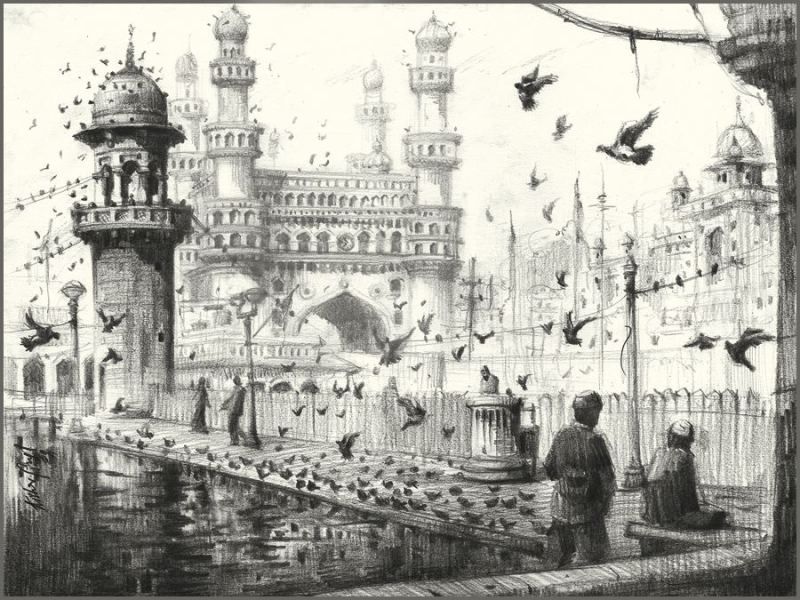
Hyderabad, to me, had its own charms; it was an amazing blend of what the Nizams left behind and what the IT boom did to it. Amidst the biryani from Paradise, the Kanjeevaram draped, coconut oiled and jasmine haired women, the turmeric smeared feet, the IT and SFO connections, where nearly every house had a son living in the US of A, the potted tulsi plants and rangolis, the old world charm of Golconda Fort, Salar Jung Museum, the Charminar, the narrow by lanes around it that sold silks, Kalamkari and Bidri art, lac bangles, pearls and Haleem, there was a bustling metropolitan, where women drove home safe at two in the morning, the tap water “manjeera” was ready to drink, the queues moved faster than most other cities and no one complained of eve-teasing, rape or sexual harassment at work.
Also, I can’t do justice to Hyderabad, if I don’t talk about the Hyderabadi Hindi. My first rendezvous on the road on the very first day was just a curtain raiser. But talking about Hyderabadi Hindi, it is bound to connect you to the memories of our erstwhile Bollywood comedian Mahmud. It is so uniquely coarse, delightfully tangy and surprisingly sweet at the same time that I developed an intense ear for it and picked up conversations from wherever they happened. On one such incident of eavesdropping, I heard someone say "Visa Balaji." My ears had not been particularly efficient in picking the right pronunciations, so I made no assumption this time and queried, “what?”
“Tumko nai maloom, amma?” By now I was used to being called Amma. So long as no one called me Behenji, it seemed acceptable. My maid Saroja, took great delight in enriching my knowledge by answering my quest. “Visa balaji sabka visa karta.” I thought she was talking about a travel agent, Balaji and Venkat were undoubtedly the two most common names for all shops and men that I knew of in Hyderabad. “Balaji kaun? Agency?” I probed.
“Nahin amma, Balaji bagwaan.” And she touched her forehead. “Tirupati balaji bagwaan, tum janta na?”
Yes, I knew her “Balaji bagwaan” but had not met him in person, I joked. Saroja seemed not bothered by my insolent humour. Instead she suggested, “Tum jao Balaji ko bolo. Tumhara bhi visa ho jayega. Idhar kayekoo raheta? Sab phoren jata. Tum bhi jao.” 
I can’t say whether it was on her insistence or my own relocation plans somewhere in the back of my mind, that I took Saroja’s suggestion seriously and decided to pay a visit to the pilgrimage in Chilkur, a small village at about an hour’s drive from Hyderabad. The folklore around it went thus: One particular devotee of the Lord Narayan or Balaji was too old/feeble to go pay a visit to the Lord in his temple. But the devotee’s yearnings were so sincere and intense that Balaji made an appearance in his own modest hut to bless him. The hut was now transformed into a temple. 
What I saw there left me enthralled: men, women, children, denim clad teenagers with branded coolers, the ready to hop on to the next flight to Silicon Valley kind young adults, the devotees came in thousands each day, perambulating the inner circle of the shrine, praying and pledging to offer gifts and donations, should Balaji once listen to their prayers and ensured that the passports got the respective desired visa stamps. 
There was something so spectacular about the temple, the faith that drove these hundreds of thousands of believers and I started visiting it again and again. Not for a visa, not even for a wish to be granted but to be a part of the whole spiritual experience of submission and faith in the power of the divine.
On one such morning at the start of the Bengali New Year, I decided to visit Chilkur again. Unfortunately, luck was not on my side that morning. I missed the alarm, woke up late and struggled to get out of the morning traffic of Hyderabad. Once I was out, I missed the exit and had to drive another 20 kms before I reached the first U-turn. By the time I reached Chilkur, it was almost midday, hot, sultry and the summer sun was harsh on the skin. The temple as usual was crowded with devotees streaming in from luxury coaches, station wagons from far off villages, cars and tempos. I must have been behind 2000 people in the snaking queue that moved at a snail’s pace. It was only after a couple of hours of waiting when I entered the inner shrine from the outer premise of the temple, that I started hoping to catch a glimpse of the deity. Little did I know that the door was soon to be shut for the “Bhog” or lunch recess. Almost an inch away from the main altar, just as I was about to step in, the head priest raised his hand and stopped the queue from moving. It was time for Bhog he announced. The temple would only open after Balaji had rested well. By then, I was leading the queue. I don’t know if the frustration showed on my face or it was something else, he called out to me in fluent English, “You, come here. Help me clean the flowers from the floor and the inner shrine. “
With that, before I knew it, he handed me a basket and took one himself, and we collected the marigolds and roses strewn on the altar at the feet of the Lord. Finally when it was done, the priest signalled for me to step into the inner shrine where the Lord was seated. “No rush, you can pray.” He said gently placing a silver crown on my head in blessing. I stood there, transfixed, unable to comprehend the significance of the whole situation. All I now remember is that I mumbled something about being grateful, and asking for strength, endurance and courage to be myself.
What followed next was rather an interesting fact. I don’t know if it was the blessing of the much revered “Visa Balaji Bagwaan” or just some divine coincidence, I found myself relocating to Singapore for good in just six months' time.
It was nearly a decade ago. I have not visited Hyderabad since, but when I look back, I feel a gush of warmth, of acceptance, of familiarity laced with the smell of coconut milk and curry leaves. The streets may not have sold beautiful women in wicker baskets as I had imagined at first, but they bartered beautiful memories for a pause to last a lifetime...
This article was first published in my regular column Sudhh Shakahari Desi in Bkhush.com


Wednesday, December 2, 2015

Words are all I have...

By Ananya Mukherjee

Like an unborn child stifling in my womb impatient to see the light of the world, words form inside me.
Restless, happy to be severed from any presumptuous umbilical ties, vocal and unashamed to cry out aloud.
Incomplete songs of life; distraught, lest I break the chain of thoughts
Like siblings running home, craving a family refuge in expressions.

Sunday, November 29, 2015

Saturday, November 28, 2015

Patiala Peg

By Ananya Mukherjee
Singapore

Backdrop: A freezing winter night in Patiala in the year 2001.
It was half past midnight when I heard the doorbell ring. As planned, I wrapped up my little girl in a thick woolen blanket. She was fast asleep in her long johns. Picking her as quietly as I could, I tip toed to open the hard wooden door. A sharp cold breeze whisked past me through the second layer of the net door. In the mist-filled dim greyish blue light of the staircase, I could only see the shadow of a man.
Well-built to the extent to be called athletic, he was covered in heavy woolen clothes, that included a cap drawn over his head covering most of his face. His neck was wrapped in a thick muffler. A dark leather jacket rose up to this throat.
The chilling wind was making it difficult for me to stand steady. He asked me if I were ready. I nodded my head and handed over my child to him.  Then I went in to bring my own red leather coat, cap, and gloves. With my hands trembling at the winter cold, I managed to lock the main door as noiselessly as possible and went down the staircase following him.   
We paced up the drive way without exchanging a single word.  When we had nearly reached the gate, he turned back once as if he had changed his mind. My eyes perhaps had a questioning look for he handed over my girl back to my arms and said, “I don’t want any noise. Leave the iron-gate. Let’s jump over the boundary wall. Wait, I will jump first. You pass her over. Then you jump across. “
I did as I was told. He crossed the boundary wall to the other side and waited. I passed my daughter over and jumped across. It was cold as cold it could get and we were freezing in the open lawn. We waited for a few seconds before he picked up my daughter from my arms again and went inside a dark bungalow. He came out after a few minutes and locked the doors of the house where he had just left my little girl. We hopped into his car as silently as we could and just as we were about to leave, I saw a man standing in a balcony watching us from across the road. His gaping mouth had the most incredibly horrified expression as we drove away, laughing.
Yes, you read it right. Laughing till we choked! We had just created the spiciest gossip in the neighbourhood! If you are wondering what this is all about, let me explain.
That man who I supposedly “eloped with in the wee hours of a winter night” was Colonel Bhatta, my husband’s friend and colleague in the Indian Army. We had been neighbours for almost a year. When two Bongs are thrown into a place far away from home and end up living next doors, they no longer remain friends. Between couriers of aloo posto and maacher jhol, shukto,  khichudi and kosha mangsho across boundary walls and evenings spent in Rabindra sangeet, adhunik gaan and all things Bong, they become one large family. So it was with us. Col Bhatta and his beautiful wife Shikha soon became a part of our extended family in Patiala, where my husband was pursuing a MD in Sports medicine. Needless to say, most of our memories are of moments we spent in the company of the Bhatta’s.   In hindsight, I can barely remember an evening we had dined separate in our individual homes.  Typically, our days as young mothers would be busy housekeeping and running around the kids. My daughter was particularly close to the Bhattas and picked up many of life’s first lessons in the company of our kind hearted neighbours. On a usual day, as soon as the men came back in the evenings, we would gather together, bring in some food either in their lawn or on our terrace, light up a camp fire and have a drink and dinner like one big family. There were days when the fog and the chill would get so strong, we would all slip inside huge quilts in a well heated room and chat the night through. 
It was on one of those winter nights when my husband was away, and we were having dinner together when Col Bhatta asked me how Doc was returning. I told him that my husband who was travelling by train had to disembark in Ambala Cantt ( since Patiala had no railway station) and would most likely rent a cab home.  An idea was proposed that post dinner, all five of us,  including Gungun who was two and Shubhang (their son) who was nine would join the reception troop to bring home Doc. It was meant to be a surprise. It also meant we needed to drive 40 kms in the early hours of the morning in the cold to reach Ambala Cantt station.    
Unfortunately, later in the evening, the children fell asleep too early and Shikha’s migraine surfaced from nowhere. So our plans had to be altered. Shikha proposed I leave Gungun with her and go ahead with Col Bhatta to receive my husband.
So that’s the real story, and that’s exactly what we did. However, to the spying, perceptive eye coated with conviction, it seemed like a perfect neighbourhood gossip. The incident remains etched as one of my fondest memories of the princely state of Patiala till date. 
For those of you, who associate the name of the city with the measure of liquor equivalent to 120 ml, or the extravagant Patiala Peg, here’s a story we learnt during our stay.
One of our banker friends in the Civilian community outside of the Army territory would often invite us to the Maharani Club. Located in the midst of Baradari garden in the very heart of the 6-km radius town, the majestic red tile-roofed mansion was said to resemble the pavilion of the Oval England. The architecture was a blend of the colonial influence and the royal grandeur of the erstwhile state of Patiala. Interestingly, Maharaja Bhupinder Singh of Patiala was the captain of the first cricket team that visited Britain way back in 1911. He also had an indomitable Polo team.  Before its civilized version or Tent Pegging, the army was known to play skull pegging where an army of fierce warriors would ride on their horseback, pegging skulls of their enemies’ buried half in the ground, along the way. With time, the game changed its format and friendly matches began to be organized. It was during one such “friendly” invitation that the Viceroy’s Pride arrived in Patiala for a match. For some reason, the home team felt threatened and nervous that they would face a loss and the wrath of the fearsome Maharaja, hatched a conspiracy.
On the evening before the match, the Viceroy’s Pride was invited for a drink at the Maharani Club where a double measure or the first Patiala pegs of whiskey was served. Needless to say, the Maharaja’s team won the match the next morning.  The legend of the Patiala Peg lives on.            
Patiala is a treasure trove for short story lovers. My husband’s school, the National Institute of Sports, was a part of the sprawling princely palaces and gardens right in the royal district of the city. Every trip opened up a Pandora’s Box of tales and folklore. One of the famous ones, as I now recall was about Maharaja Bhupinder Singh and his fleet of Rolls Royce cars.  When the Maharaja visited a Rolls Royce showroom in Britain and enquired the price of a premium model, he was humiliated by a salesman who doubted his affordability. The infuriated Maharaja Bhupinder Singh not only bought all the cars from the showroom, he cut open the roofs and began to use them as garbage trucks. No sooner did the news reach England, an apologetic Rolls Royce envoy requested the maharaja to return all the garbage truck and replaced them with the finest and most premium models.
It was also during our two-year stay that I picked up other gems; words in Punjabi that I would not have known by simply watching Bollywood movies or being an Army wife ( where for some reason people simply assume Punjabi to be the most spoken language after English in the mess before General Kapoor says so ). A horribly misinterpreted phone call taught me that “lukhh” had little or nothing to do with Lukhnow,  that the colour of the turban shared some hints about the clan or identity, that makki da ataa must always be kneaded with warm water and never rolled; that there was nothing so heavenly as stopping by a Dhaba on a long drive to sit and relish a freshly baked alu ka paratha with makkhan di tikki on top and a glass of malaiwali lassi; that it was perfectly normal to attend weddings with ‘Mandeep weds Mandeep’ written on floral plaques ( one just needed to ‘see’ the implied Singh and the Kaur), that no one cared if tandoori kukkad was the national bird or not so long as it found a spot in the dinner plate, that “naardana” chowk meant “anaardana”; and that a desperate looking youngster suffering from cardiac arrest like symptoms on a hot summer afternoon complaining of “book ni lagda, neend ni aandi, jee gabrata “ at our door could actually be the proud owner of a name such as Aashiq Ali.             
I also learnt a thing or two about the large heartedness and progressive mindset of the Sikh community. My many trips to Dukhniwaran Gurudwara, watching the kar sevaks, attending the langar, were the most humbling experiences of my lifetime.
And I would do little justice to my memories of Punjab if I do not mention a lady called Leela.
Leela auntie, all of 50 then was my domestic help. Her mother had come as a part of the dowry with the Maharani of Patiala. Leela auntie was born in the palace grounds and was raised serving the first family of Patiala. Before she started working for me, she had spent six years in Singapore and another four in Hong Kong working as a helper in NRI households. When she came back, from whatever money she had saved, she invested in her daughter’s college education and in building a double-storey house for herself and her family. I would often question her why she needed to work in her age, and a response would be “ Aurat ko na humesha kaam karni chahiye. Khud ka kamana chahiye. Tabhi uski izzat raheti hai,” ( A woman should always be financially independent. Only then can she get the respect).

We left Patiala in 2002 and 13 years later, as I look back at the memories and reminisce the wonderful times spent in the company of some warm hearted people with such a positive happy outlook towards life, my eyes get a wee bit misty. I am not a drinker but I might as well pour myself an extra helping of my favourite port wine and raise a toast to the Patiala Peg. Cheers! 

Wednesday, November 25, 2015

Intellectual Property

This blog is copyrighted by the author. Any reproduction, reprint or publication in whole or parts thereof in any other form without  permission is a violation of the intellectual property right and could lead to potential legal actions by the author.

Friday, November 13, 2015

A bit of a role play

Consultant: "Well, you have the highest scores that I have ever seen in optimism and stress management. Never met a profile such as yours. My own scores are pathetic. How do you manage to achieve this?"
Yours truly: ( smiling ) " Frankly, I do not know what I manage better; disappointments or dreams."
Her eyes begin to sparkle. Or maybe they are reflecting (on) mine. I leave the room smiling at the role play.

Flashback and more

In my ancestral home in North Bengal, this is the busiest time of the year. Folk lore has it that the Khan Bahadur Bhaduris many centuries back descended from a family of dacoits and made their fortune by amassing wealth and land from the kings and landlords. Before every raid, they were known to offer an animal sacrifice to the goddess Kaali. In due course, over a few generations, they became feudal lords themselves, gave up on robbery and adopted the lifestyles of Zamindars. However, the loyalty to the goddess of shakti or Kaali continued and a temple on home grounds was built over an altar of panchmundi or the sacrificed heads of five humans. Even today, the temple stands strong in the courtyard amidst the dilapidated remains of the old mansion and the modern structures where our extended families live.
Kaalipujo continued to be the most awaited festival at home and throughout my growing up years, an annual ritual for the dispersed family to reunite. During my grandmother's time, as the senior most matriarch of the Khan Bahadur Bhaduris, she was the sole controller of the elaborate family run extravaganza. Everyone else merely followed orders.
Interestingly, everyone in the village and in the neighbouring villages were invited. No one who lived within the radius of 5 kms, stayed hungry on these days. Thamma, till her 90s, continued to fast all day and prepare the Bhog for the pujo.
It was during one of those annual visits to home, that she told me a story.
Once in the midst of the festive season when her grand mom in law Bindubashini Debi was preparing the bhog, a little village girl came and stood near the main kitchen. She looked like a peasant's child, matted hair and frail, and someone probably from a lower caste. How she had found access to the zamindari kitchen or the courtyard of a bramhin family was unknown. The girl apparently spread out her hand begging for food. Bindubashini Debi was so engrossed in cooking for the goddess that she snapped at her insolence, explained that it was bhog meant for Ma Kaali, ignored the child and ordered the servants to drive her away. No one eats what's prepared for the gods before it is offered in prayers. Only after the bhog is religiously offered, can the prasad be distributed amongst devotees. The little girl went away forlorn and sad.
That night Bindubashini Debi had a dream where she saw Ma Kaali rebuking her in her sleep and refusing to accept the bhog. " I came to your doorstep asking for food and you drove me away. Now I shall not touch your bhog," the sad Goddess said. Bindubashini Debi must have realised her mistake for she sought forgiveness and declared that the whole village and its neighbourhood be invited for the pujo. A decree was passed that no one within 5 km radius of the zamindari would sleep hungry that night and if anyone ever asked or begged for food even meant to be offered to the gods, it must be given out to the person first.
For generations, we have stuck by the unique code. In all our festivals and prayers, in rituals and celebrations, it is always about practising human first, then God.
May Ma Kaali, the goddess of Shakti give you strength, courage and power!

The Distance

How far are you from yourself?
Half a breath away. 
Always? 
No. When I am alone.
And with people around?
A few million light years, sometimes.

Thursday, November 5, 2015

Sing me a song, Ma!

Lullabies or loris. Are they things of the past?
I don't know what lullabies or loris our kids will sing to their next generations, but I still love the ones I grew up listening to in my childhood and sang to Gungun before putting her to sleep every single night when she was a baby. There used to be something so innocently beautiful about the ritual....change into your night suit, brush your teeth and slip inside the quilt. In that dim soft light of the bedroom, my Mamma would hum to me, gently patting all the while, songs, ballads, rhymes....I followed the same ritual with Gungun. She needed her lori, learnt her first songs and poems and even participated in singing them in return to a tired "sooo jaa ab meri maa" me. As I look back, the simple act fills me with a beautiful memory of bonding, of passing a culture and a tradition to the next generation. No?

Dugga Dugga

It is almost impossible to observe, reflect and then honestly narrate the juicy chronicles of a Barowari Probashi Durga Pujo (the annual Community Bong festival) without rattling a few cages and raising a few well- trimmed eyebrows (they already look arched high enough with the pujo chaant , like an expression of perennial surprise; a couple of millimeter more would hit the roof….oops, the hairline)!! Shhhh.. I was just being polite. I actually meant opening a can of creepy crawly worms. Eeeks…I can see you cringing at that! Trust me, so am I. To be absolutely truthful, and I cross my heart as I say this, that’s a just a simple breakdown of what we, the flag bearers of back stage management and front row audience, call Poro Ninda Poro Chorcha or PNPC in short.
You do not know what PNPC is? You gotta be kidding or you are not qualified to be a Bong! Ok, let me have the exclusive privilege of enlightening you on the fodder that we live on. PNPC is the staple bong diet after the bhoger khichuri for any community Durga Pujo, whether in homeland or on foreign shores. It is a must; like the panchamrita that cleanses your soul post fasting? There you get it! It is the quintessential detox of the Bong mind….just throw up all the snide remarks, nose twitches, lop sided smiles, sarci jokes at one go and there you are the decontaminated pure spirit ready to absorb the blessings of the sacred mantras and indulge in more observation of the clan around you.
For once, even I cannot slip into my self-assumed social anthropologist’s role watching the antics of a known tribe without identifying with it. So let’s get back to the real scene. Did you read “battlefield”? Oh no! We are the “kaalchaared” intellectual genes. PNPC is never done aloud. We do all this very subtly and if you are the probashi Bong, there are chances you would not even get it. It could start with a simple query: “Tumi Kolkatar?” (Are you from Kolkata?) . You are dead, if you dare say “yes” and later reveal an address that’s indicative of a pincode in South 24 Parganas. “Narendrapur abar Kolkata naki? Bollei holo!” ( Since when did Narendrapur become Kolkata! Crap). Well…to the unsuspecting mind, it is just the beginning to a compartmentalization, almost as definite as the MBTI test if you have ever taken one. The next lines of questions are somewhat predictable. Ghoti na Bangaal? North Cal or South? Which school did you say? You are saved again if your school has a reputation to be hip. Even better if you have a convent tag attached to your alumni and can sing the commonest school prayer “Our Father, thou art in heaven….” to perfection. Also, even if you do not drop slangs as punctuation marks in your conversations, you must know what they mean! “JU? No wonder!!” With each question, mind you, you are becoming a part of a quadrant and don’t ask me the axes!
Now that you have been measured (up and down) and somewhat fit into a prototype of a certain creed of Bongs, we will look at your clothes…yes, the saree and goyna cannot find a better exhibition than the puja mandap. Commissioned designer exclusives to Gariahat morer stalls, copies of Sabyasachi and Satya Paul to online carbon prints, displaying your wardrobe over five glorious days is the heart of Bong Durga Pujo. There can be nothing as traumatic as discovering the lady standing beside you at pushanpanjali wearing a saree similar to yours. Did I say traumatic? Read catastrophic! The dokaandaar who promised you “ektai piece didi” is dead and so is dear hubby who spent some few hundred dollars buying you the best this Pujo. The shoes too would not go unnoticed. Dare you show your heels and mismatch your Dhakai saree with red velvet shoes or don’t have a Kolhapuri mojri to accessorize your Dhuti Panjabi and see how the world drags you to your feet! Also, be sure to watch a few mobile PC Chandra versions walk up and down the aisle and pujo stage. As a kid, I wondered why women dressed up in sheets of gold, jewelry that looked like Raavan’s collection to me. With age, I have learnt that the catch here is not to be demoralized by the bullion market. It is also not about what you flash but when you procured it. How much of what you own is heirloom and how much of it has been acquired recently. Nouveau riche or ancestral wealth determines your genre again. A typical bong compliment could be: “ Natun gorali? Bah besh” ( Is that a new one? Wow nice) and the aside remark to follow can be as “conclusive” as “Kichhui chilona agey; shobi ekhon goracche.” (Had nothing before, see she is getting them now) Ahem! The complexities of what’s right and what is not, is debatable.
Of course, we are not a bitchy tribe. We are fantastic intelligent people, almost always bestowed with good looks or some talent, be it painting, singing, writing, acting, dancing, photography or simply dressing up. And one could find ample demonstrations of each in the Pujo Mondop. We do it well and we do it with all our competence. In other words, we are competent and we are competitive. The only flipside is, sometimes, everyone is clamoring for a space on the stage and there are few cheerleaders and audience on the ground: Bathroom singers, gawky dancers, school sketchbook artists, birthday card writers and everyone with a DSLR camera or with a husband who has a DSLR which is one and the same thing in this instance. Having said all that, pujo is what tugs at the heart of all Bongs everywhere in the world, no matter whether it is a “ghoroa” pujo in Johannesburg or the full on “dhoomdhaam” at Singapore or London or the weekend get together in Bay Area. It is about community bonding, and all things Bong, food, adda, music, dance, dressing up, and if PNPC is such an integral part of the BONG DNA, so be it!!
We do not even spare our gods. I just heard someone say, “Maayer mukutta ektu byenka. Kartik ki ektu tyera naaki re? Uff Lokkhir sareeta ki gyeyo. Sarashwatir hashita bhari mishti. Ar oshur ke dekh, puro tamil movier hero…” ( Isn’t ma durga’s crown a bit tilted? Kartik looks cock eyed, Lakshmi's saree is so behenji type and Saraswati has a cute smile. Asur looks like a hero from a Tamil film…”) Till the next one! Dugga Dugga!! Ashche bocchor abar hobe!

The article was first published in my regular column Shuddh Shakahari Desi on Bkhush.com